Get Free Consultation!
We are ready to answer right now! Sign up for a free consultation.
I consent to the processing of personal data and agree with the user agreement and privacy policy

We are ready to answer right now! Sign up for a free consultation.
I consent to the processing of personal data and agree with the user agreement and privacy policy
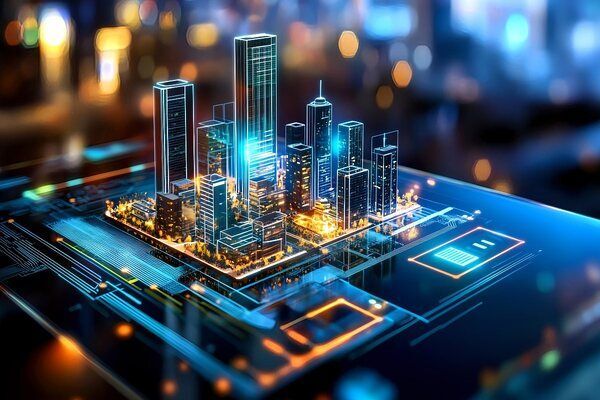
Did you know there’s a new market quietly emerging at the intersection of technology and real estate—one that could redefine digital infrastructure as we know it. After a decade dominated by the cloud and “classical” data centers, the next frontier is already taking shape: Quantum Real Estate.
According to JLL’s ‘Future of Quantum Real Estate’ report, quantum computing is rapidly moving toward commercial viability, with global investments projected to reach $20 billion annually by 2030.
For real estate developers, governments, and institutional investors in the GCC, this is more than a trend—it’s an untapped opportunity that will reward those who act with foresight, speed, and strategic execution.
What is Quantum Real Estate?
To understand the $20 billion leap forecasted by JLL, we must look at the physical requirements of the technology. Quantum startups raised approximately $2 billion in 2024, with global revenues under $750 million. However, the forecast suggests a precipitous climb: reaching $10 billion annually by 2027 and doubling to $20 billion by the end of the decade.
Unlike standard commercial offices or even modern data centers, quantum computers require highly specialized, “extreme” environments.
We are talking about infrastructure that provides:
These requirements make one thing clear: the traditional “plug-and-play” real estate model will not work. We are entering an era of hybrid quantum-classical facilities that require entirely new design, build, and operational models.
The GCC’s Structural Advantage
The GCC isn’t just well-positioned—it could dominate this space. If leveraged correctly, these advantages can convert future quantum flows into high-value jobs and regional wealth. With access to patient sovereign capital and the ability to execute large-scale infrastructure projects rapidly, the region can move faster than most global competitors.
In a race where speed and precision define leadership, this execution advantage could become the GCC’s most decisive edge.
The GCC is roughly equidistant between Asia, Europe, and Africa. This provides a massive time-zone advantage for global operations and distributed quantum networks. With robust subsea fibre connections already in place, the region is a natural hub for data redundancy.
Quantum machines need pristine stability. The GCC offers vast land reserves removed from urban “electromagnetic clutter.” Furthermore, while the climate is hot, the region has mastered large-scale cooling and offers increasingly low-cost power through massive renewable energy (solar) projects.
Unlike Western markets that rely heavily on fragmented private venture capital, GCC governments can align policy, land, and capital through sovereign wealth funds. This allows for the creation of “special zones” specifically designed for quantum infrastructure.
Closing the Current Gap
Despite its strengths, a critical gap remains. Quantum ecosystems don’t grow in isolation—they are built on a powerful “Triple Helix” of academia, R&D, and highly specialized talent. While the GCC has made significant progress through global partnerships and research initiatives, it has yet to match the deep quantum expertise of established hubs like Silicon Valley and parts of Europe.
But this isn’t a limitation—it’s a window of opportunity. Closing this gap will require a decisive shift—from importing innovation to actively building it at scale.
A 5-Point Roadmap for GCC Stakeholders
This is not a distant opportunity—it’s a near-term infrastructure shift already underway. Early movers will not only capture value but define the standards others will be forced to follow. To ensure the region doesn’t miss out on this $20 billion revolution, five strategic objectives must be prioritized:
The Bottom Line
By 2030, quantum real estate won’t be a niche—it will sit at the core of global digital infrastructure. The next trillion-dollar infrastructure cycle won’t be built in the cloud—it will be built on land. For the GCC, this is more than an opportunity—it’s a chance to shift from technology consumer to global infrastructure leader. Those who act early won’t just participate in the quantum age—they will own the ground it’s built on.
Source: JLL ‘Future of Quantum Real Estate’ Report | gulfnews.com